


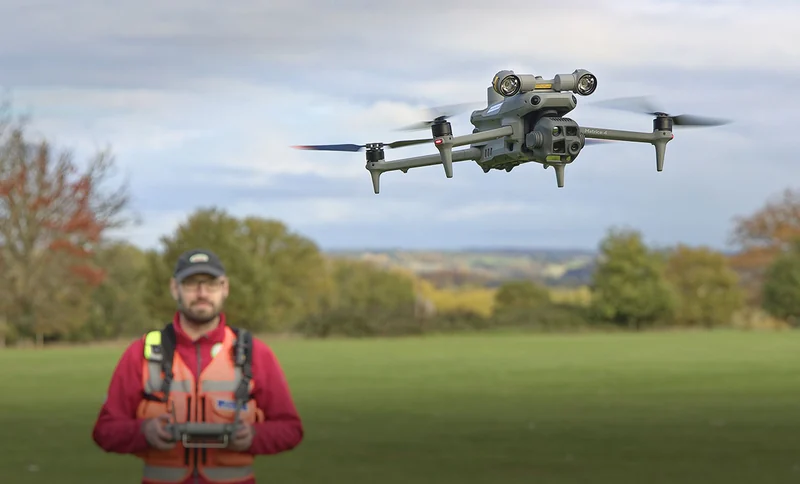
The thermal camera helps locate temperature anomalies. Cable detection serves a different purpose during flight: it helps the crew identify obstacles. In a supervised demo, test the quality of the thermal image and the reliability of cable detection separately under your working conditions.
DJI introduced the Matrice 5T on November 5, 2026 for work such as power-line inspection and locating thermal anomalies. If you are comparing drones, ask for a supervised demonstration at your working distance and evaluate the thermal footage separately from cable detection. The two features address different parts of an inspection. [1] [2]
What the thermal camera adds
The camera records thermal video at 30 frames per second with a native resolution of 1280 × 1024. DJI also lists a 2560 × 2048 enhanced-resolution image mode. When reviewing a sample, check which mode produced it. These figures describe different outputs, and a comparison of exported images without that information can confuse the dimensions of the file with the detail an operator can actually identify. [2]
Consider a supervised inspection trial in which a crew wants to locate a spot that is warmer than nearby components. The crew could choose a known target and compare images from the same distance and angle. If two drones are involved, record the capture mode on each and keep the surrounding conditions as similar as possible. The practical question is whether a technician can locate the warm area, associate it with the right component and retain enough detail for later review. The initial sighting directs that review. A diagnosis of the component still requires the applicable inspection procedure.
How to read the 32-metre figure
DJI combines LiDAR, millimetre-wave radar and wide-angle cameras for obstacle sensing. The company describes LiDAR as a way to detect thin objects in darkness and radar as an aid when fog, rain or dust affects visibility. The cameras provide additional information about the surroundings. DJI reports nighttime cable detection at up to 32 metres in controlled testing. That figure describes the test conditions, and actual detection distance depends on the environment. [1] [2]
A field comparison could start with an approved, de-energized test target at a controlled site. The supervisor sets the approach limit and stop criteria ahead of time. The crew can record when the first alert appears, whether it persists as the viewing angle changes and whether it repeats across passes. Recording the target thickness and visibility gives the results some context. If an alert drops out, record the interruption without moving closer to trigger another alert. This example evaluates detection consistency within the operating margin already set by the crew.
Keep a record of unsuccessful passes as well. If a reflection or a change in the background makes the component harder to identify, note which pass it happened on and keep the relevant frame. That gives a dealer a specific issue to address in a second demonstration. It also helps the crew decide whether a change in capture technique could solve the problem or whether the difficulty affects an essential part of the inspection.
Where sales were confirmed
DJI announced sales from November 5 through authorized DJI Enterprise dealers. In Japan, authorized dealer System Five confirmed that day it had begun offering the model. The international announcement does not give country-level stock or prices. For Spain and other markets, the sources reviewed leave unit availability and delivery times unconfirmed. A local dealer can clarify what is included in its configuration and whether a demonstration unit is available. [1] [3]
A crew that already carries out inspections can base its decision on two separate outcomes. First, determine whether the thermal capture documents an anomaly with the detail its technician needs. Then assess whether obstacles are detected consistently within the crew’s operating margin. Comparing both outcomes in the same session makes it easier to judge how the aircraft fits the actual job. It also gives the crew a record of the conditions under which each result was obtained.
Image caption. Unmodified archive photo of a DJI Matrice 4T in flight, the predecessor to the Matrice 5T. Blsar-sar / Wikimedia Commons, CC BY-SA 4.0. [4] [5]